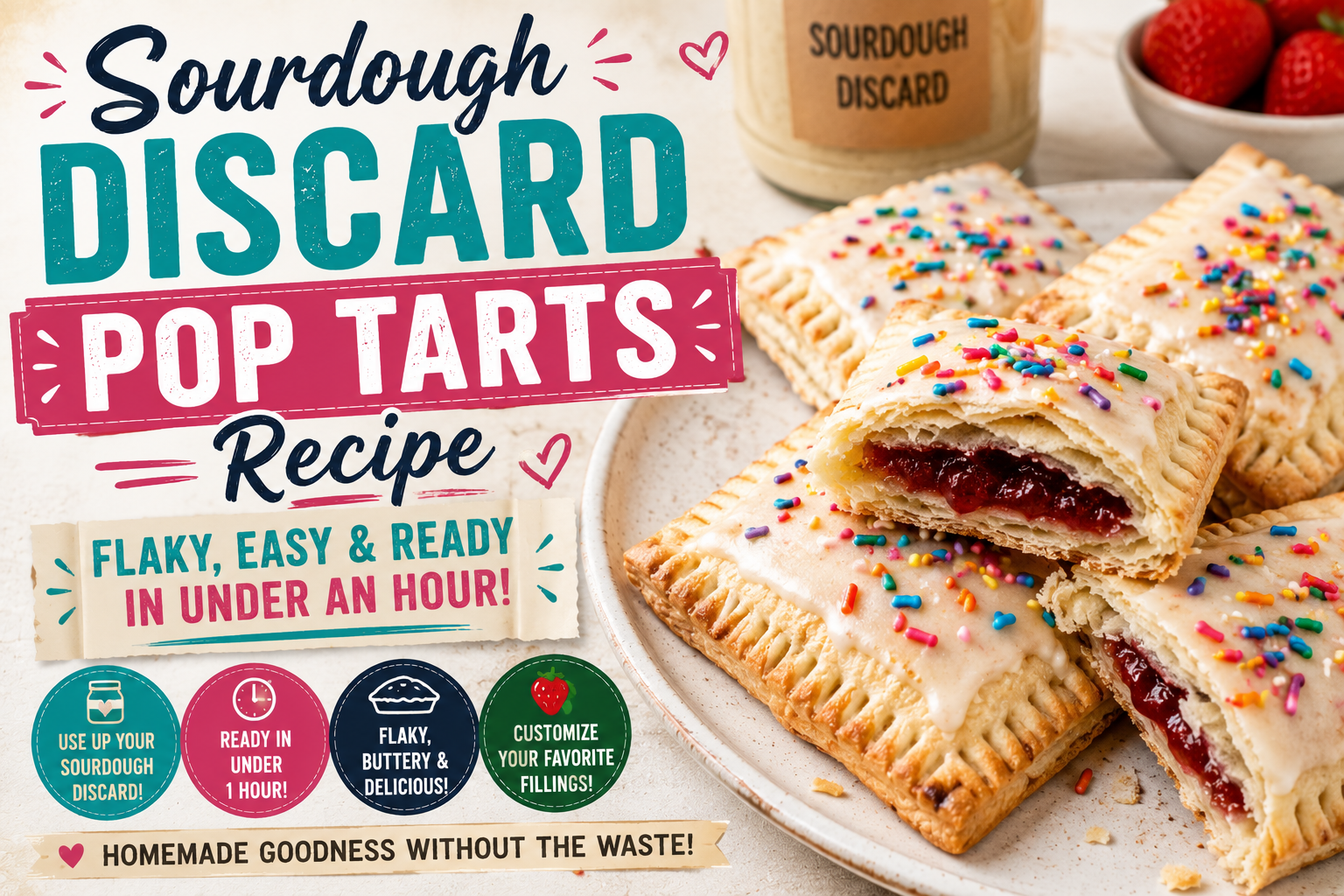
There is something about a warm, homemade pop tart that makes everything feel right. The crisp snap of a golden, buttery crust. The jammy, sweet filling that pools at the centre. The drizzle of glaze that sets just enough to hold its shape but still melts on contact with your tongue.
Now imagine that same experience — but better. A crust with a subtle, complex tang from sourdough discard. Layers of genuine flakiness from properly cold butter worked into the dough. Strawberry jam that stays where it is meant to stay rather than erupting from the sides. And the whole thing done in under an hour, start to finish.
These Sourdough Discard Pop Tarts are what happens when a childhood favourite grows up. They are made from scratch, they use the sourdough discard that would otherwise go down the drain, and they taste so dramatically better than anything that comes wrapped in foil from a box that going back simply stops being an option.
What Makes These Pop Tarts Different?
The pop tart you remember from childhood was convenient, consistent, and engineered to survive a shelf. Homemade sourdough pop tarts are none of those things and are better in every way that actually matters.
The sourdough discard is the key distinction. Sourdough discard — the portion of starter that is removed during feeding — contains natural wild yeast and lactic acid bacteria that have been developing flavour in the flour and water over time. When worked into a pastry dough, it contributes a subtle, pleasant tang that cuts through the sweetness of the jam and the richness of the butter. The result is a flavour complexity that standard pastry dough, made with flour and water alone, simply cannot replicate.
The butter technique is the second distinction. Cold, cubed butter worked into flour using a fork or pastry cutter creates pockets of fat throughout the dough. When those pockets hit the heat of the oven, they release steam and push the layers of dough apart, creating the laminated, flaky texture that makes a pastry genuinely satisfying rather than merely edible. This is the same principle behind croissants, pie crusts, and rough puff pastry — and it works beautifully here.
The white vinegar is the quiet ingredient most home bakers would not expect to find in a pastry recipe. A small amount of acid inhibits gluten development in the flour, producing a more tender, delicate crust that stays crisp without becoming tough. It is a professional baker’s trick that makes a genuine difference in the final texture.
Why This Recipe is Perfect for Sourdough Bakers
Every sourdough baker knows the mild guilt of discarding. When you feed an active starter, you remove a portion before adding fresh flour and water. This discarded starter is not useless — it is full of flavour — but unless you have a recipe ready, it ends up in the bin.
This recipe is the perfect destination for that discard. It requires exactly half a cup — a typical amount removed during a standard feeding — and it uses it within an active baking session rather than requiring the discard to be stored separately for days. No special timing. No extra planning. Just a quick, delicious use for something that would otherwise be wasted.
Ingredients
For the Sourdough Pastry Dough (Makes 4 Pop Tarts)
- 1 cup + 1 teaspoon all-purpose flour
- 8 tablespoons unsalted butter — cold, cut into small cubes
- ½ teaspoon fine sea salt
- 2 tablespoons granulated sugar
- ½ cup sourdough discard
- 1 teaspoon white vinegar
For the Filling
- ½ cup strawberry jam — use high-quality store-bought or homemade
For the Egg Wash
- 1 egg, lightly beaten
For the Glaze
- ½ cup powdered sugar
- 1 teaspoon water — add more for a thinner glaze
How to Make Sourdough Pop Tarts — Step by Step
Step 1: Mix the Dry Ingredients
In a large mixing bowl, combine the flour, fine sea salt, and granulated sugar. Whisk together until evenly mixed and the bowl smells faintly of flour. This dry mix becomes the structural foundation of the pastry dough — getting it uniform before the butter goes in ensures even distribution throughout.
Step 2: Work in the Cold Butter
Add the cold, cubed butter to the flour mixture. Using a fork or pastry cutter, press and cut the butter into the flour until the mixture resembles coarse, uneven crumbs. Some pieces of butter should be the size of small peas — this unevenness is intentional and desirable. Those larger pieces of butter will create the distinct flaky layers in the baked crust.
The single most important rule in this step: the butter must be cold. Cold butter does not melt into the flour — it stays in distinct pieces that retain their structure during mixing and only release their fat during baking, when the heat converts them into steam pockets between the dough layers. Warm or softened butter blends into the flour completely and produces a crumbly, mealy texture with none of the flakiness you are aiming for.
If the kitchen is warm, return the bowl to the refrigerator for 10 minutes after working in the butter before proceeding.
Step 3: Add the Sourdough Discard and Vinegar
Pour in the sourdough discard and white vinegar. Stir gently until a shaggy, slightly sticky dough forms. Do not overmix. The moment the dry ingredients are fully incorporated and no dry flour remains visible, stop mixing. Overworked pastry dough develops gluten, which makes the finished crust tough and resistant rather than tender and flaky.
The dough will be rougher and less polished than a standard pastry dough at this stage — this is correct.
Step 4: Chill the Dough
Wrap the dough tightly in plastic wrap, pressing it into a flat disc rather than a ball — a disc chills more evenly and rolls out more easily. Refrigerate for at least 30 minutes. One hour is better if you have the time.
This chilling step does two things simultaneously. It re-solidifies the butter that was softened slightly during mixing, restoring the cold fat pockets that create flakiness. It also relaxes the gluten strands that formed during mixing, making the dough easier to roll without it springing back.
Never skip this step. The ten minutes you might save by skipping it costs you the flakiness of the finished product.
Step 5: Roll and Cut the Dough
Preheat your oven to 375°F (190°C) while the dough chills. Remove the dough from the refrigerator and place it on a lightly floured surface. Roll it out to approximately ⅛ inch thickness — thin enough to be genuinely flaky but thick enough to hold the filling without tearing.
Using a sharp knife, pizza cutter, or pastry cutter, cut the dough into rectangles measuring approximately 3 inches by 4 inches. You should get 8 rectangles in total — 4 will serve as the bases and 4 as the tops. Try to keep the dimensions as uniform as possible so the matching halves align cleanly.
If the dough warms up and becomes difficult to work with during rolling, return it to the refrigerator for 10 minutes before continuing.
Step 6: Fill and Seal
Place 4 of the rectangles on a parchment-lined baking sheet. These are the bases. Spoon approximately 1 tablespoon of strawberry jam into the centre of each base, leaving a clear border of at least ½ inch around all edges. Do not be tempted to add more jam — the filling expands during baking and excess jam will force its way through even a well-sealed edge, creating a sticky, burnt mess on the baking sheet and a lopsided pop tart.
Place the remaining 4 rectangles on top of the filled bases, aligning the edges as precisely as possible. Press the edges together firmly with your fingertips to create an initial seal. Then use a fork to crimp all four edges — pressing the tines firmly into the dough to create a decorative and functional seal that holds the filling inside during baking.
Finally, use the fork to pierce the top of each pop tart 2 to 3 times. These small holes allow steam from the filling to escape during baking, which prevents the tops from puffing up excessively and cracking open.
Step 7: Apply the Egg Wash and Bake
Lightly beat the egg in a small bowl. Using a pastry brush or your fingertips, apply a thin, even coat of egg wash over the surface of each pop tart. The egg wash performs a specific function that no other ingredient can replicate — the proteins and fats in the egg brown in the oven through the Maillard reaction, producing the deep golden colour and slightly shiny finish that makes a pastry look professionally baked rather than homemade.
Bake at 375°F for 28 minutes until the pop tarts are deeply golden brown and crisp. The bottom of each tart should sound hollow when tapped lightly.
Step 8: Cool and Glaze
Transfer the baked pop tarts to a wire rack and allow them to cool for 10 minutes before glazing. This cooling time is important — a glaze applied to a too-hot surface melts immediately and runs off rather than setting on the pastry.
While the pop tarts cool, whisk together the powdered sugar and water until smooth. For a thicker, more opaque glaze that stays on the surface, use 1 teaspoon of water. For a thinner glaze that flows into the crimped edges and pooled on the surface, add water half a teaspoon at a time until you reach the consistency you prefer.
Drizzle the glaze over the cooled pop tarts in whatever pattern pleases you. Allow it to set for a few minutes before serving.
The Secret to a Truly Flaky Crust
Flakiness in pastry is not a mystery — it is a temperature problem. Every element of this recipe that produces flakiness comes down to one variable: keeping the butter cold until it hits the oven.
Cold butter worked into flour stays in distinct, separate pieces. When the cold pastry enters the hot oven, those butter pieces melt rapidly and release steam. The steam pushes against the surrounding dough, separating it into thin layers. Those thin layers set in the heat of the oven. The result is flakiness — dozens of thin, distinct layers of baked pastry that shatter under the slightest pressure.
Warm butter blends into the flour, fills the gaps, and creates a uniform, shortbread-like texture. Still good. Not flaky.
For maximum flakiness: start with butter straight from the refrigerator, work quickly, chill the dough before and during rolling if it warms up, and bake in a properly preheated oven so the butter hits high heat immediately rather than warming slowly.
Filling Variations to Try
The strawberry jam filling is the classic starting point, but the sourdough pastry dough works beautifully with a wide range of fillings. Here are the best alternatives:
Raspberry Jam — slightly more tart than strawberry, with a more intense fruit flavour and a vivid jewel-like colour that shows beautifully when the pop tart is cut open.
Blueberry Jam — deep, sweet, and slightly jammy in a way that pairs especially well with the tang of the sourdough crust. Homemade blueberry compote with a little lemon zest is exceptional here.
Apricot Jam — bright, slightly acidic, and less sweet than most berry jams. The fruit flavour is more complex and the colour is beautiful.
Nutella or Chocolate Hazelnut Spread — intensely satisfying, especially when warm. Use 1 tablespoon per pop tart and ensure the edges are sealed extra firmly as the spread can liquefy and leak during baking.
Brown Sugar and Cinnamon — mix 2 tablespoons of brown sugar with 1 teaspoon of cinnamon and a small pinch of salt. Spread evenly across the base rectangle. This filling is the closest recreation of the original frosted cinnamon pop tart and is deeply nostalgic.
Lemon Curd — tart, bright, and luxurious. Use 1 teaspoon per pop tart as it is more fluid than jam and more prone to leaking. Seal the edges very firmly.
Glaze Variations and Decoration Ideas
The basic powdered sugar glaze is a clean, simple finish — but it is also just the beginning.
Vanilla Glaze — add ¼ teaspoon of pure vanilla extract to the standard glaze for a warmer, more aromatic flavour.
Pink Strawberry Glaze — blend 1 teaspoon of strawberry jam into the glaze before drizzling for a pink-tinted glaze that echoes the filling and looks stunning.
Lemon Glaze — replace the water with fresh lemon juice for a sharp, citrus glaze that cuts through the richness of the butter pastry.
Cream Cheese Glaze — beat 2 tablespoons of softened cream cheese into the powdered sugar before thinning with cream. Richer, tangier, and closer to a proper frosting.
Sprinkles — press rainbow sprinkles into the wet glaze before it sets for a nostalgic, colourful finish that makes these pop tarts genuinely feel like the childhood version — just enormously better.
How to Store Sourdough Pop Tarts
Room temperature: Store in an airtight container for up to 2 days. The crust will soften slightly over time as the glaze draws moisture — this is normal.
Refrigerator: Store in an airtight container for up to 1 week. The flavour actually improves slightly after a day as the sourdough tang in the crust develops further.
Freezer: Wrap each pop tart individually in plastic wrap, place in a freezer-safe bag, and freeze for up to 3 months. Freeze without the glaze for the best results. Thaw at room temperature and add the glaze fresh before serving.
Reheating: For the best texture, reheat in a toaster oven at 300°F for 4 to 5 minutes. The crust will crisp back up beautifully. Microwave reheating works but softens the crust significantly — acceptable for a quick warm-through but not ideal for experiencing the full flaky texture.
Troubleshooting — What Went Wrong?
Filling is leaking out during baking: Too much jam was used, or the edges were not sealed firmly enough. Stick to 1 tablespoon of jam per pop tart and make sure the fork crimping is pressed firmly into the dough all the way around.
Crust is tough instead of flaky: The dough was overmixed, the butter was too warm, or the dough was not chilled sufficiently before rolling. Pastry dough should be handled minimally and kept cold throughout.
Pop tarts spread and lose their shape: The dough warmed up before baking. If the assembled pop tarts sit at room temperature for more than a few minutes before going in the oven, return them to the refrigerator for 10 minutes first.
Glaze is too thick or too thin: Adjust by adding water half a teaspoon at a time to thin it, or more powdered sugar a tablespoon at a time to thicken it.
Bottom is pale while top is golden: The baking sheet is positioned too high in the oven. Move the rack to the centre or lower-centre position for more even bottom heat.
Frequently Asked Questions
Can I use active sourdough starter instead of discard?
Yes. Active starter at any stage of its feeding cycle works in this recipe. The flavour will be slightly more pronounced with older, more acidic discard, but fresh active starter produces excellent results.
What if I do not have sourdough discard?
The sourdough discard can be approximated by mixing ¼ cup of all-purpose flour with ¼ cup of water. The dough will behave similarly but the finished pop tarts will lack the subtle tang that makes sourdough pastry distinctive. For the truest flavour, there is no real substitute for actual discard.
Can I make the dough the night before?
Yes — the dough can be made, wrapped tightly, and refrigerated overnight. An extended cold rest of 8 to 12 hours actually produces slightly more flavour development in the sourdough component and is perfectly fine from a pastry texture standpoint. Remove the dough from the refrigerator and let it sit at room temperature for 5 minutes before rolling.
Why does this recipe use white vinegar?
White vinegar is a mild acid that limits gluten development in the flour during mixing. Less gluten means a more tender, delicate pastry that is easier to roll and produces a more delicate crumb after baking. It is a classic professional pastry technique and the amount used is small enough that no vinegar flavour is detectable in the finished product.
Can I double this recipe?
Yes. Double all ingredient quantities and work in two batches if your bowl size limits you. The doubled recipe produces 8 pop tarts, which store and freeze well. If making a large batch, keep the unused portions of dough in the refrigerator while you assemble and bake the first batch.
Final Thoughts
Store-bought pop tarts are a memory. A good one, maybe — warm and sweet and wrapped in foil in a way that felt special at seven years old. But they are also engineered food, built for shelf life and consistency rather than flavour and texture.
These Sourdough Discard Pop Tarts are real pastry. A crust with genuine flakiness from real cold butter. A filling that tastes like actual fruit. A subtle, interesting tang from fermented flour and water that makes the sweet elements taste sweeter by contrast. Done in under an hour.
Once you make them, the box version stops making any sense at all. These are better in every way — and they use the sourdough discard you were about to throw away. That is the kind of kitchen win that deserves to be made every single weekend.
RECIPE CARD:
- Prep Time: 30 minutes
- Chill Time: 30 minutes
- Bake Time: 28 minutes
- Total Time: 58 minutes
- Servings: 4 pop tarts
- Calories: 480 kcal per serving
- Cuisine: American
- Course: Breakfast, Snack, Dessert
- Diet: Vegetarian